Compare your lender’s renewal offer with a negotiated offer and a written switching offer before deciding. Staying can make sense when the complete cost and contract fit your plans. Switching can make sense when the savings or useful features justify the costs, you qualify with the new lender, and the transfer can finish on time.
Start with the balance, remaining amortization and maturity date on your statement. A lower monthly payment can come from spreading the debt over more years. Check the repayment period and the balance you would still owe at the end of the comparison.
Get three comparable written offers
Ask your current lender for its initial renewal offer, then ask whether it can improve the rate or terms. Obtain a competing written offer for the same borrowing need. The FCAC renewal guide recommends shopping around and negotiating. It does not establish that a broker, bank or credit union always offers the lowest cost.
For a useful comparison, match the starting balance, remaining amortization, payment frequency, rate type, term and start date. Record whether each offer is an estimate, a conditional approval or a commitment with conditions still outstanding.
| Item | What to put in writing |
|---|---|
| Borrowing and dates | Balance, remaining amortization, maturity date, new start date and term end date. |
| Rate and payment | Fixed or variable; payment structure; compounding; rate or prime discount; principal-and-interest payment. |
| Costs and incentives | Each fee, who pays it, when it is due, coverage limits and any repayment condition on an incentive. |
| Flexibility | Lump-sum privileges, payment increases, porting conditions, restrictions on refinancing and early-exit charges. |
| Approval and completion | Income, credit, property and legal conditions; deadlines; the person coordinating the payout and registration. |
If you compare a three-year offer with a five-year offer, use the same ending date and show an assumption for the rate after the shorter term expires. Today’s three-year rate does not establish your borrowing cost for years four and five.
Compare payments, fees and the debt left over
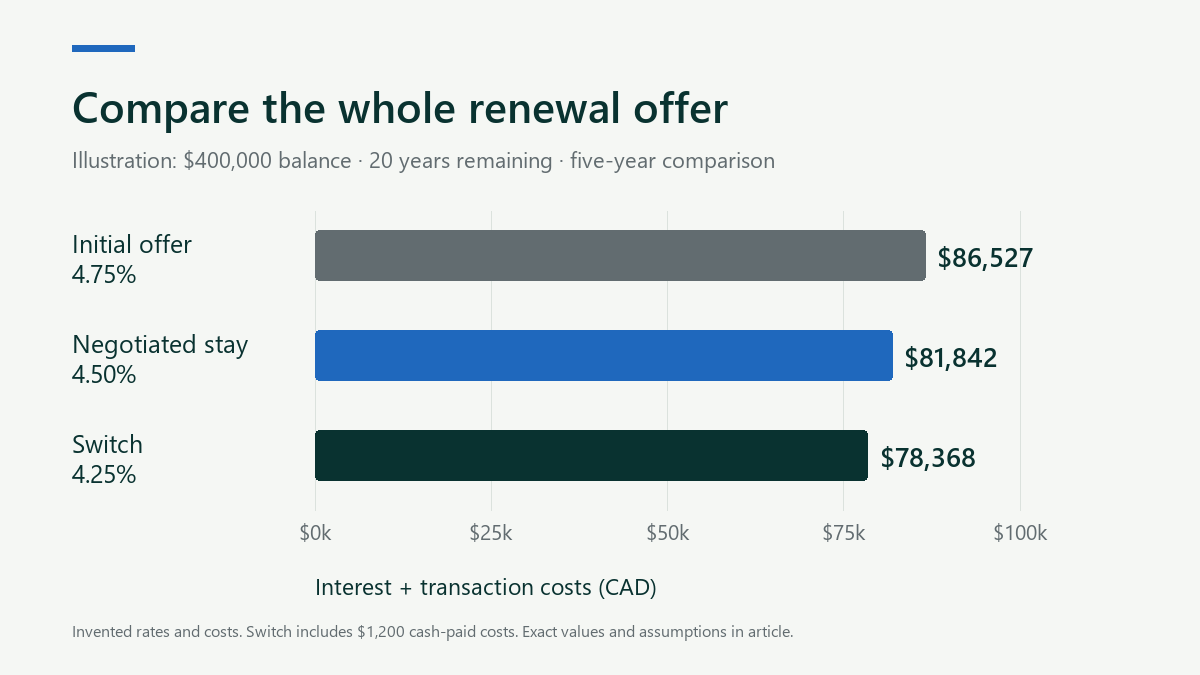
This illustration starts with a $400,000 balance and 20 years of amortization remaining. All three options run for five years. The switching option has $1,200 of costs paid in cash. These are invented comparison inputs, not current rates, available offers or a borrower case.
On a narrow screen, scroll the table horizontally to compare every column.
| Measure | Initial offer | Negotiated stay | Switch |
|---|---|---|---|
| Annual rate | 4.75% | 4.50% | 4.25% |
| Monthly principal and interest | $2,574.78 | $2,521.62 | $2,469.02 |
| Total mortgage payments | $154,486.80 | $151,297.20 | $148,141.20 |
| Balance after five years | $332,040.49 | $330,544.82 | $329,027.15 |
| Interest over five years | $86,527.29 | $81,842.02 | $77,168.35 |
| Cash-paid transaction costs | $0.00 | $0.00 | $1,200.00 |
| Interest plus transaction costs | $86,527.29 | $81,842.02 | $78,368.35 |
In this example, switching costs $8,158.94 less than accepting the initial offer, but $3,473.67 less than the negotiated stay. Negotiating changes the comparison materially. These differences apply only to the stated rates, costs and five-year horizon.
The calculation checks both cash and debt:
Interest plus cash-paid costs = mortgage payments + ending balance − starting balance + cash-paid costs.
For the switch, that is $148,141.20 + $329,027.15 − $400,000 + $1,200 = $78,368.35. Principal repayment is already included in the reconciliation. Adding the lower ending balance to the interest saving a second time would overstate the benefit.
A lower-cost offer can still be unsuitable if its restrictions conflict with a likely move, refinance or lump-sum payment. Price those events separately using the actual contract. Ask for an exit-cost estimate at the date you expect to need flexibility.
Account for the complete cost of switching
Request a dated payout statement and an itemized transfer estimate. Depending on the file, costs may include discharge, registration, legal or notary work, appraisal, administration and repayment of an earlier cash incentive. Ask whether a quoted cost is included in another line so you do not count it twice. The FCAC discharge guide explains why the lender, province and legal work affect the bill.
Confirm your registration type. With a collateral charge, other loans secured by the same charge may need to be repaid or transferred too. Obtain a list of those debts and the new lender’s instructions. A transfer-cost promotion may have exclusions, maximum reimbursements or conditions that require you to repay the benefit later.
Keep fees paid in cash separate from fees added to the mortgage. Financing a cost raises the opening loan balance and can create additional interest. A comparison that assumes identical starting balances must be recalculated if one offer adds fees to principal.
Confirm qualification before relying on a switch
An exemption from a prescribed stress-test rate does not guarantee approval. OSFI’s straight-switch policy applies to eligible uninsured, stand-alone amortizing, non-readvanceable mortgages moving between federally regulated financial institutions. The remaining contractual amortization must not increase and equity must not be taken out. The policy permits up to $3,000 of transaction costs to be added to the balance.
The receiving lender still assesses the application. Confirm income, debts, credit, property and its own lending requirements. A mortgage-plus-credit-line arrangement, additional borrowing, an amortization extension or a different type of lender needs its own assessment. Ask which rule applies to your exact transaction.
If switching is unavailable, compare the renewal offer you can obtain, negotiate where possible and discuss affordability with the existing lender early. FCAC describes support expectations for federally regulated mortgage lenders when borrowers face financial difficulty. Those expectations have a defined scope and do not promise identical relief from every lender.
Work backwards from your maturity date
Begin comparing a few months ahead, allowing time for underwriting, any appraisal and legal completion. Ask each lender for its own rate-hold expiry and document deadlines. A rate hold and an immediate change to your mortgage are different arrangements; confirm when the new rate actually starts and what you would be signing.
A federally regulated lender must provide a renewal statement at least 21 days before the term ends. Use that as a notice requirement, rather than a recommended shopping window. Your statement should explain any automatic renewal. Do not assume every lender uses the same fallback term or rate.
- Confirm maturity, balance, remaining amortization and charge type.
- Collect and negotiate comparable offers while checking eligibility.
- Reconcile fees, payments, ending balances and features.
- Confirm approval conditions and completion responsibilities before committing.
Bring the comparison to a mortgage professional
In BC, ask who the broker represents, how they expect to be paid, which options they can consider, and why a recommendation suits your circumstances. BCFSA’s disclosure guidance and suitability and material-risk guidance explain the relevant disclosure framework and its exceptions.
Request help to compare your renewal offer with a possible switch. This opens a general enquiry. Include your maturity date and the questions you want to resolve. Ask how to share financial documents securely before sending account statements or identification.
The mortgage services overview explains renewal, switching and refinancing situations if your borrowing needs have also changed.
Sources and calculation method
Public guidance checked on 9 November 2026. The example is an original amortization calculation, independently checked using a second calculation method and a cash-and-balance reconciliation. It illustrates a comparison method and does not recommend a product for an individual borrower.
All amounts are Canadian dollars. The amortizing examples convert a nominal annual rate compounded twice a year to an equivalent monthly rate. Payments occur at month end and are rounded to cents. Interest and balances retain full precision until the displayed totals are rounded. Actual contracts may use different compounding, day counts or payment rules. Taxes, insurance, extra payments, missed payments, incentives and the time value of money are excluded.