Early mortgage renewal can be worthwhile when the interest saved before your current maturity date exceeds the penalty and other costs, and the new contract fits your plans. If the new rate is higher than your existing rate, changing now can increase costs even when the lender waives a penalty. Get the effective date, fees and new maturity date in writing.
First establish what the lender is offering. A rate held for a future start date, an immediate early renewal, a blend-and-extend and a switch before maturity can have different financial consequences.
Separate the four options
| Option | How to evaluate it |
|---|---|
| Rate hold for a future start | Confirm the rate or prime discount held, expiry date, conditions, any cost, whether acceptance is binding and whether a lower rate can be requested. The existing mortgage continues until the agreed change date. |
| Early renewal with the same lender | Confirm when the new rate begins, whether the old term ends, every waived or payable charge and the new term end date. |
| Blend-and-extend | Obtain the lender’s blended rate, calculation, fees, effective date and new maturity. Compare its complete payment schedule with waiting and other available offers. |
| Break and switch before maturity | Obtain the existing lender’s payout statement, all new setup costs and the receiving lender’s approval conditions. Confirm restrictions on breaking the current contract. |
The FCAC preapproval guide describes rate holds that vary by lender. A quoted hold period does not establish a universal penalty-free early-renewal window. For example, TD describes a 120-day early-renewal window for its customers. That is provider-specific guidance, not a rule for every Canadian mortgage.
Ask this directly: “Does my current payment or rate change now, or are we arranging the next term for maturity?” Then confirm the answer in the document you would sign.
Get the actual cost of changing now
Breaking a closed mortgage normally creates a prepayment charge. Its calculation depends on the contract. Many fixed-rate contracts use the greater of three months’ interest and an interest-rate differential, but the relevant rates, discounts, restrictions and exceptions vary. An open mortgage permits prepayment without a prepayment penalty, although other charges may still exist.
Use the lender’s written payout figure for the proposed date. The FCAC penalty guide explains why estimates can differ and which questions to ask. Also list administration, discharge, appraisal, legal or registration costs, and any incentive repayment. Verify which costs are waived and whether the waiver carries conditions.
For a blend-and-extend, FCAC explains that a lender may offer an extension without a prepayment penalty while still charging administration fees. Its blended-rate example is expressly simplified. Use your lender’s actual blended rate and payment schedule for the decision.
Compare costs through the original maturity date
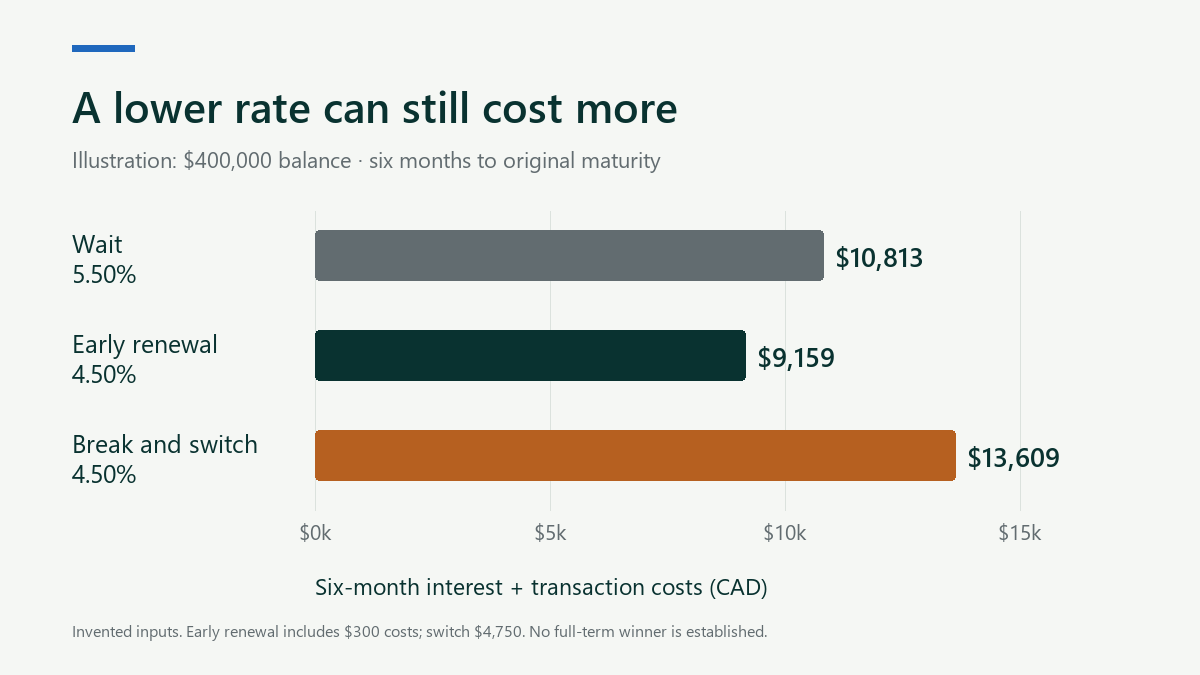
Here is an illustration with $400,000 owing, 20 years of amortization remaining and six months until the current mortgage matures. Waiting keeps a 5.50% rate for those six months. Two hypothetical alternatives start at 4.50% now, with different transaction costs. These inputs are invented, not offers, market averages or a real borrower file.
On a narrow screen, scroll the table horizontally to compare every column.
| Measure | Wait at 5.50% | Early renewal at 4.50% | Break and switch at 4.50% |
|---|---|---|---|
| Monthly principal and interest | $2,737.57 | $2,521.62 | $2,521.62 |
| Total mortgage payments | $16,425.42 | $15,129.72 | $15,129.72 |
| Balance at original maturity | $394,387.36 | $393,729.05 | $393,729.05 |
| Interest over six months | $10,812.78 | $8,858.77 | $8,858.77 |
| Cash-paid transaction costs | $0.00 | $300.00 | $4,750.00 |
| Interest plus transaction costs | $10,812.78 | $9,158.77 | $13,608.77 |
The $300 early-renewal cost and $4,750 break-and-switch cost are hypothetical totals. No assumption is made that a lender would allow this six-month early renewal or charge either amount.
On these inputs, early renewal costs $1,654.01 less than waiting through the original maturity date. Breaking and switching costs $2,795.99 more than waiting, even though both alternatives have the same lower rate and payment.
The payment reduction is $215.95 a month. Six months of lower payments releases $1,295.70 of cash, but that is not the interest saving. The lower-rate alternatives also finish with $658.31 less debt. Adding those two differences gives the $1,954.01 interest saving before transaction costs.
Compare mortgage payments + ending balance − starting balance + cash-paid costs. Include a financed fee in the opening balance and its payment schedule, rather than counting it again as a cash-paid cost.
Check the commitment beyond that comparison date
The six-month calculation answers what changing now costs before the existing mortgage would have matured. It does not prove which option is cheapest over a new three- or five-year term. Starting a new term today changes the next renewal date, and the rate available if you wait is unknown.
For a longer comparison, use a common ending date and show multiple assumptions for future rates, fees and any second renewal. Keep a separate scenario for an earlier sale or refinance. A favourable result under one assumed path cannot establish that the path will occur.
If your current rate is below the proposed rate, calculate the cost of giving it up early. If your objective is certainty at maturity, investigate a future rate hold before assuming you need an immediate new term. A lender’s hold and float-down conditions determine what protection is actually available.
Confirm approval, flexibility and completion
A new lender must approve the file. Income, credit, debts, the property and the borrowing request matter. OSFI’s minimum qualifying-rate guidance includes an exception for eligible uninsured straight switches at renewal. It is not a blanket exemption for an early refinance, extra borrowing or an amortization extension.
Review prepayment privileges, porting, refinancing restrictions, conversion terms and the cost of another early exit. A penalty waiver today can be outweighed by restrictions on the replacement mortgage. Ask the lender to explain any feature you expect to use during the new term.
Questions to resolve before signing
- What is my original maturity date, and exactly when does this new rate take effect?
- Is this a rate hold, a binding commitment, an immediate renewal or a blend-and-extend?
- What is the dated payout amount, and which fees or incentive repayments remain?
- What are the payments and balance owing at the same comparison date under each option?
- When does the replacement term end, and what would an earlier move or refinance cost?
- Which approval conditions remain, and who coordinates completion?
BCFSA’s suitability and material-risk guidance identifies significant fees, early-exit restrictions and payment risks as considerations in assessing mortgage options. Ask the professional advising you to explain why the proposed change fits your circumstances.
Request help to compare early renewal with waiting. The contact page opens a general enquiry. Share your maturity date and the decision you need help with, and ask how to provide the contract and payout statement securely.
If you need additional borrowing as well as a new rate, review the renewal and refinancing services overview before treating the transaction as a simple renewal.
Sources and calculation method
Public sources checked on 9 November 2026. The original example uses monthly amortization schedules and an independent calculation check. It includes no forecast, eligibility decision or recommendation for a particular borrower.
All amounts are Canadian dollars. The amortizing examples convert a nominal annual rate compounded twice a year to an equivalent monthly rate. Payments occur at month end and are rounded to cents. Interest and balances retain full precision until the displayed totals are rounded. Actual contracts may use different compounding, day counts or payment rules. Taxes, insurance, extra payments, missed payments, incentives and the time value of money are excluded. Transaction costs are paid in cash at the start. Rates after the original maturity date are outside the six-month calculation.